Person Page - 153
Greenwood Wilson
#4505, b. 1833
Greenwood Wilson|b. 1833|p153.htm#i4505|John Wilson|b. 19 Sep 1806|p75.htm#i2236|Martha Sheard|b. 18 Mar 1809|p62.htm#i1879|Daniel Wilson|b. 13 Nov 1785\nd. 24 Jan 1857|p108.htm#i3224|Letitia Fox|b. 4 Oct 1784\nd. 1 Nov 1852|p121.htm#i3587|George Sheard|b. 1773\nd. 1835|p4.htm#i106|Ann Greenwood|b. 4 Jul 1775\nd. 1832|p43.htm#i1285|
Relationship=2nd cousin 4 times removed of Vivien Eley.
Greenwood Wilson was born in 1833 at Batley. He was the son of John Wilson and Martha Sheard. Greenwood Wilson was baptized on 10 November 1833 at Batley.1
In the census of 6 June 1841 he was listed as the son of John Wilson at Havercroft, Batley.2
In the census of 30 March 1851 he was listed as a piecer at a factory the son of John Wilson at Havercroft, Batley.3
In the census of 6 June 1841 he was listed as the son of John Wilson at Havercroft, Batley.2
In the census of 30 March 1851 he was listed as a piecer at a factory the son of John Wilson at Havercroft, Batley.3
Citations
- [S1] Microfiches CMB, All Saints Batley.
- [S4] 1841 census: HO107 for Batley (online image) "Class: HO107; Piece 1267; Book: 4; Civil Parish: Batley; County: Yorkshire; Enumeration District: 6; Folio: 43; Page: 14; Line: 22; GSU roll: 464238."
- [S5] 1851 census for Batley (online image) "Class: HO107; Piece: 2322; Folio: 300; Page: 16; GSU roll: 87553-87554."
Isaac Wilson
#4506, b. 1840
Isaac Wilson|b. 1840|p153.htm#i4506|John Wilson|b. 19 Sep 1806|p75.htm#i2236|Martha Sheard|b. 18 Mar 1809|p62.htm#i1879|Daniel Wilson|b. 13 Nov 1785\nd. 24 Jan 1857|p108.htm#i3224|Letitia Fox|b. 4 Oct 1784\nd. 1 Nov 1852|p121.htm#i3587|George Sheard|b. 1773\nd. 1835|p4.htm#i106|Ann Greenwood|b. 4 Jul 1775\nd. 1832|p43.htm#i1285|
Relationship=2nd cousin 4 times removed of Vivien Eley.
Isaac Wilson was born in 1840 at Batley. He was the son of John Wilson and Martha Sheard. Isaac Wilson was baptized on 1 June 1840 at Batley.1
In the census of 6 June 1841 he was listed as the son of John Wilson at Havercroft, Batley.2
In the census of 30 March 1851 he was listed as a piecer at a factory the son of John Wilson at Havercroft, Batley.3
In the census of 7 April 1861 he was listed as a factory boy the son of John Wilson at Quarry, Batley.4
In the census of 6 June 1841 he was listed as the son of John Wilson at Havercroft, Batley.2
In the census of 30 March 1851 he was listed as a piecer at a factory the son of John Wilson at Havercroft, Batley.3
In the census of 7 April 1861 he was listed as a factory boy the son of John Wilson at Quarry, Batley.4
Citations
- [S1] Microfiches CMB, All Saints Batley.
- [S4] 1841 census: HO107 for Batley (online image) "Class: HO107; Piece 1267; Book: 4; Civil Parish: Batley; County: Yorkshire; Enumeration District: 6; Folio: 43; Page: 14; Line: 22; GSU roll: 464238."
- [S5] 1851 census for Batley (online image) "Class: HO107; Piece: 2322; Folio: 300; Page: 16; GSU roll: 87553-87554."
- [S6] 1861 census RG9 for Batley (online image) "Class: RG9; Piece: 3400; Folio: 52; Page: 19; GSU roll: 543126."
Dan Wilson
#4507, b. 4 September 1842
Dan Wilson|b. 4 Sep 1842|p153.htm#i4507|John Wilson|b. 19 Sep 1806|p75.htm#i2236|Martha Sheard|b. 18 Mar 1809|p62.htm#i1879|Daniel Wilson|b. 13 Nov 1785\nd. 24 Jan 1857|p108.htm#i3224|Letitia Fox|b. 4 Oct 1784\nd. 1 Nov 1852|p121.htm#i3587|George Sheard|b. 1773\nd. 1835|p4.htm#i106|Ann Greenwood|b. 4 Jul 1775\nd. 1832|p43.htm#i1285|
Relationship=2nd cousin 4 times removed of Vivien Eley.
Dan Wilson was born on 4 September 1842 at Batley. He was the son of John Wilson and Martha Sheard. Dan Wilson was baptized on 4 December 1842 at Batley.1
In the census of 30 March 1851 he was listed as a scholar the son of John Wilson at Havercroft, Batley.2
In the census of 7 April 1861 he was listed as a factory boy the son of John Wilson at Quarry, Batley.3
In the census of 30 March 1851 he was listed as a scholar the son of John Wilson at Havercroft, Batley.2
In the census of 7 April 1861 he was listed as a factory boy the son of John Wilson at Quarry, Batley.3
Citations
- [S1] Microfiches CMB, All Saints Batley.
- [S5] 1851 census for Batley (online image) "Class: HO107; Piece: 2322; Folio: 300; Page: 16; GSU roll: 87553-87554."
- [S6] 1861 census RG9 for Batley (online image) "Class: RG9; Piece: 3400; Folio: 52; Page: 19; GSU roll: 543126."
James John Sheard Wilson
#4508, b. 1847
James John Sheard Wilson|b. 1847|p153.htm#i4508|John Wilson|b. 19 Sep 1806|p75.htm#i2236|Martha Sheard|b. 18 Mar 1809|p62.htm#i1879|Daniel Wilson|b. 13 Nov 1785\nd. 24 Jan 1857|p108.htm#i3224|Letitia Fox|b. 4 Oct 1784\nd. 1 Nov 1852|p121.htm#i3587|George Sheard|b. 1773\nd. 1835|p4.htm#i106|Ann Greenwood|b. 4 Jul 1775\nd. 1832|p43.htm#i1285|
Relationship=2nd cousin 4 times removed of Vivien Eley.
James John Sheard Wilson was born in 1847 at Batley. He was the son of John Wilson and Martha Sheard. James John Sheard Wilson was baptized on 13 July 1847 at Batley.1
In the census of 7 April 1861 he was listed as a shoe maker the son of John Wilson at Quarry, Batley.2
James John Sheard Wilson married Margaret Burnley in 1869.3
In the census of 7 April 1861 he was listed as a shoe maker the son of John Wilson at Quarry, Batley.2
James John Sheard Wilson married Margaret Burnley in 1869.3
Children of James John Sheard Wilson and Margaret Burnley
- Dan Wilson b. 1870
- Harry Newsome Wilson b. 1875
Citations
- [S1] Microfiches CMB, All Saints Batley.
- [S6] 1861 census RG9 for Batley (online image) "Class: RG9; Piece: 3400; Folio: 52; Page: 19; GSU roll: 543126."
- [S13] < and [0]>, Free BMD, Dewsbury 1869 Q3 Vol 9b p160.
Walter White
#4509, b. 1811, d. 1893
Walter White was born in 1811. He wrote "A Month in Yorkshire" in 1858 and included in his Yorkshire travels was Batley. I think he gives so good an account of Shoddy production at the time that I reproduce it here:-.1
"The object of my visit to Batley was to see the making of shoddy. To leave Yorkshire ignorant of one of our latest national institutions would be a reproach. We live in an age of shoddy, in more senses than one. You may begin with the hovel, and trace shoddy all through society, even up to the House of Peers. I had not long to wait: ther was a bird's eye view of Dewsbury in passing, and a few minutes brought me to Batley, the head-quarters of shoddy. On alighting at the station, the sight of great pockets or bales piled up in stacks or laden on trucks, every bale branded Anvers, and casks of oil from Sevila, gave me at once a proof that I had come to the right place; for here were rags shipped at Antwep from all parts of Northern Europe. Think of that. Hither were brought tatters from pediculous Poland, from the gipsies of Hungary, from the beggars and scarecrows of Germany, from the frowsy peasants of Muscovy; to say nothing of snips and shreds from monks'gowns and lawyers' robes, from postilions' jackets and soldiers uniforms, from maidens' bodices and noblemans' cloaks. A vast medley, truly! and all to be manufactured into broadcloth in Yorkshire. No wonder that the Univers declares England is to perish by her commerce.
The walk to the town gives you such a view as can only be seen in a manufacturing district: hills, fields, meadows, and rough slopes, all bestrewn with cottages, factories and warehouses, sheds, clouded here and there by smoke; roads and paths wandering apparently anywhere; here and there a quarry, and piles of squared stone; heaps of refuse; wheat fields among the houses; potato plots in little levels, and everything giving you the impression of waiting to be finished. Add to all this, troops of men and women, boys and girls - the girls with a kerchief pinned over the head, the corner hanging behind - going home to dinner, and a mighty noise of clogs, and trucks laden with rags and barrels of oil, and you will have an idea of Batley, as I saw it on my arrival.
Having found the factory of which I was in search, i had to wait a few minutes for the appearance of the principal. A boy, who was amusing himself in the office, remarked, when he heard that I had never yet seen shoddy made: "Well, it'll cap ye when ye get among the machinery; that's all!" He himself had been capt once in his life: it was in the previous summer, when his uncle took him to Blackpool, and he first beheld the sea. "That capt me, that did," he said, with the gravity of a philosopher.
Seeing that the principal hesitated, even after he had read my letter, I began to imagine that shoddy-making involved important secrets. "Come to see what you can pick up, eh?" he said. However, when he heard that I was in no way connected with manufactures, and had come, not as a spy, but simply out of honest curiousity, to see how old rags were ground into new cloth, he smiled, and led me forthwith into the devil's den.There I saw a cylinder revolving with a velocity too rapid for the eye to follow, whizzing and roaring, as if in agony, and throwing off a cloud of light woolly fibres, that floated in the air, and a stream of flocks that fell in a heap at the end of the room. It took three minutes to stop the monster; and when the motion ceased, I saw the cylinder was full of blunt steel teeth, which, seizing whatever was presented to them in the shape of rags, tore it thoroughly to pieces; in fact ground it up into flocks of short, frizzly-looking fibre, resembling negro-hair, yet soft and free from knots. The cylinder is fed by a travelling web, which brings a layer of rags continually up to the teeth. On this occasion, the quality of the grist, as one might call it, was respectable - nothing but fathoms of list which had never been defiled. So rapidly did the greedy devil devour it, that the two attendant imps were kept fully employed in the feeding; and fast as the pack of rags diminished, the heap of flocks increased. And so, amid noise and dust, the work goes on day after day; and the man who superintends, aided by his two boys, earns four pounds a week, grinding the rags as they come, for thirty shillings a pack.
The flocks are carried away to the mixing-house. As we turned aside, the devil began to whirl once more; and before we had entered the other door, I heard the ferocious howl in full vigour. the road between the buildings was encumbered withh oil-casks, pieces of cloth, lying in the dust, as if of no value, and packs of rags. "It will all come right by-and-by," said the chief, as I pointed to the littery heaps; and, pausing by one of the packs which contained what he called 'mungo,' that is shreds of such cloth as clergymans' coatw are made of, he made me aware that there is shoddy and shoddy. that which makes the longest fibre is, of cours, the best; and some of the choice sorts are worked up into marketable cloth, without a fresh dyeing.
Great masses of the flocks, with passage ways between, lay heaped on the stone floor of the mixing house. Here, according to the quality required, the long fibre is mixed in certain quantities with the short; and to facilitate the subsequent operations, the several heaps are lightly sprinkled with oil. A dingy brown or black was the prevalent colour; but some of the heaps were gray, and would be converted into undyed cloth of the same colour. It seemed to me that the principal ingredient therein was old worsted stockings; and yet before many days, these heaps would become gray cloth fit for the jackets and mantles of winsome maidens.
I asked my conductor if it were true, as I had heard, that shoddy-makers purchased the waste, begrimed cotton wads with which stokers and 'engine-tenters' wipe the machinery, or the dirty refuse of wool-sorters, or every kind of ragged rubbish. He did not think such things were done in Batley; for his part, he used none but the best rags, and could keep two factories always going. He had heard of the man who spread greasy cotton-waste over his field, and who, when the land had absorbed all the grease, gathered up the cotton, and sold it to the shoddy-makers; but he doubted the truth of the story. True or not, it implies great toleration among a certain class of manufacturers. Rags, not good enough for shoddy, are used as manure for the hops in Kent; so we get shoddy in our beer as well as in our broadcloth.
In the next process, the flocks are intimately mixed by passing over and under a series of rollers, and come forth from the last looking something like wool. Then the wool, as we may now call it, goes to the 'scribbling machine,' which, after torturing it among a dozen rollers of various dimensions, delivers it yard by yard in the form of a loose thick cable, with a run of the fibres in one direction. the carding-machine takes the cable lengths, subjects them to another course of torture, confirms the direction of the fibres, and reduces the cable intoa chenille of about the thickness of a lady's finger. This chenille is produced in lengths of about five feet, across the machine, parallel with the rollers, and is immediately transferred to the piecing machine, by a highly ingenious proces. Each length, as it is finished, drops into a long, narrow, tin tray; the tray moves forward; the next behind it receives a chenille; then the third; then the fourth, and so on, up to ten. By this time, they have advance over a table on which lies what may be described as a wooden gridiron; ther is a momentary pause, and then the trays, turning all at once upside down, drop the chenilles severally between the bars of the gridiron. At one side of the table is a row of large spindles, or rollers, on which the chenilles - cardings is the factory word - are wound, and the dropping is so contrived that the ends of those which fall overlap the ends of the lengths on the spindles by about an inch. Now the gridiron begins to vibrate, and by its movement beats the ends together; joins each chenille, in fact, to the one before it; then the spindles whirl, and draw in the lengths, leaving only enough for the overla; and no sooner is this accomplished than the ten trays drop another supply, which is treated in the same expeditious manner, until the spindles are filled. No time is lost, for the full ones are immediately replaced by empty ones.
Now comes the spinners' turn. they take these full spindles, submit them to the action of their machinery by dozens at a time, and spin the large, loose chenilles into yarns of different degrees of strength and fineness, or, perhaps one should say, coarseness, ready for the weavers. And in this way these heaps of short, uncompliant negro-hair, in which you could hardly find a fibre three inches long, are transformed into long, continuous threads, able to bear the rapid jerks of the loom. I could not sufficiently admire its ingenuity. Who would have imagined that among the appliances of shoddy! Moreover, wages are good at Batley, and the spinners can earn from forty to forty-five shillings a week. the women who attend the looms earn nine or eighteen shillings a week, according as they weave one or two pieces.
Next comes the fulling process; the pieces are damped, and thumped for a whole day by a dozen ponderous mallets;then the raising of the pile on one or both sides of the cloth, either by rollers or by hand. In the latter case, two men stretch a piece as high as they can reach on a vertical frame, and scratch the surface downwards with small hand-cards, the teeth of which are fine steel wire. Genuine broadcloth can only be dressed by a teazel of nature's own growing; but shoddy, far less delicate, submits to the metal. so the men keep on, length after length, till the piece is finished. Then the dyers have their turn, and if you venture to walk through their sloppy, steamy department, you will see men stirring the pieces about in vats, and some pieces hanging to rollers which keep them for a while running through the liquor. From the dye-house the pieces are carried to the tenter-ground and stretched in one length on vertical posts; and affter a sufficient course of sun and air, they undergo the finishing process - clipping the surface and hot-pressing.
From what I saw in the tenter-ground, I discovered that pilot cloth is shoddy; that glossy beavers and silky-looking mohairs are shoddy; that the 'fabric' of Talmans, Raglans, and paletots, and of other garments in which fine gentlemen go to the Derby, or to the Royal Academy Exhibition, or to the evening services in Westminster Abbey, are shoddy. And if Germany sends us abundance of rags, we send to Germany enormous quantities of shoddy in return. the best quality manufactured at Batley is worth ten shillings a yard; the commonest not more than one shilling.
Broadcloth at a shilling a yard almost staggers credibility. After that we may truly say that shoddy is a great leveller".
He died in 1893.
"The object of my visit to Batley was to see the making of shoddy. To leave Yorkshire ignorant of one of our latest national institutions would be a reproach. We live in an age of shoddy, in more senses than one. You may begin with the hovel, and trace shoddy all through society, even up to the House of Peers. I had not long to wait: ther was a bird's eye view of Dewsbury in passing, and a few minutes brought me to Batley, the head-quarters of shoddy. On alighting at the station, the sight of great pockets or bales piled up in stacks or laden on trucks, every bale branded Anvers, and casks of oil from Sevila, gave me at once a proof that I had come to the right place; for here were rags shipped at Antwep from all parts of Northern Europe. Think of that. Hither were brought tatters from pediculous Poland, from the gipsies of Hungary, from the beggars and scarecrows of Germany, from the frowsy peasants of Muscovy; to say nothing of snips and shreds from monks'gowns and lawyers' robes, from postilions' jackets and soldiers uniforms, from maidens' bodices and noblemans' cloaks. A vast medley, truly! and all to be manufactured into broadcloth in Yorkshire. No wonder that the Univers declares England is to perish by her commerce.
The walk to the town gives you such a view as can only be seen in a manufacturing district: hills, fields, meadows, and rough slopes, all bestrewn with cottages, factories and warehouses, sheds, clouded here and there by smoke; roads and paths wandering apparently anywhere; here and there a quarry, and piles of squared stone; heaps of refuse; wheat fields among the houses; potato plots in little levels, and everything giving you the impression of waiting to be finished. Add to all this, troops of men and women, boys and girls - the girls with a kerchief pinned over the head, the corner hanging behind - going home to dinner, and a mighty noise of clogs, and trucks laden with rags and barrels of oil, and you will have an idea of Batley, as I saw it on my arrival.
Having found the factory of which I was in search, i had to wait a few minutes for the appearance of the principal. A boy, who was amusing himself in the office, remarked, when he heard that I had never yet seen shoddy made: "Well, it'll cap ye when ye get among the machinery; that's all!" He himself had been capt once in his life: it was in the previous summer, when his uncle took him to Blackpool, and he first beheld the sea. "That capt me, that did," he said, with the gravity of a philosopher.
Seeing that the principal hesitated, even after he had read my letter, I began to imagine that shoddy-making involved important secrets. "Come to see what you can pick up, eh?" he said. However, when he heard that I was in no way connected with manufactures, and had come, not as a spy, but simply out of honest curiousity, to see how old rags were ground into new cloth, he smiled, and led me forthwith into the devil's den.There I saw a cylinder revolving with a velocity too rapid for the eye to follow, whizzing and roaring, as if in agony, and throwing off a cloud of light woolly fibres, that floated in the air, and a stream of flocks that fell in a heap at the end of the room. It took three minutes to stop the monster; and when the motion ceased, I saw the cylinder was full of blunt steel teeth, which, seizing whatever was presented to them in the shape of rags, tore it thoroughly to pieces; in fact ground it up into flocks of short, frizzly-looking fibre, resembling negro-hair, yet soft and free from knots. The cylinder is fed by a travelling web, which brings a layer of rags continually up to the teeth. On this occasion, the quality of the grist, as one might call it, was respectable - nothing but fathoms of list which had never been defiled. So rapidly did the greedy devil devour it, that the two attendant imps were kept fully employed in the feeding; and fast as the pack of rags diminished, the heap of flocks increased. And so, amid noise and dust, the work goes on day after day; and the man who superintends, aided by his two boys, earns four pounds a week, grinding the rags as they come, for thirty shillings a pack.
The flocks are carried away to the mixing-house. As we turned aside, the devil began to whirl once more; and before we had entered the other door, I heard the ferocious howl in full vigour. the road between the buildings was encumbered withh oil-casks, pieces of cloth, lying in the dust, as if of no value, and packs of rags. "It will all come right by-and-by," said the chief, as I pointed to the littery heaps; and, pausing by one of the packs which contained what he called 'mungo,' that is shreds of such cloth as clergymans' coatw are made of, he made me aware that there is shoddy and shoddy. that which makes the longest fibre is, of cours, the best; and some of the choice sorts are worked up into marketable cloth, without a fresh dyeing.
Great masses of the flocks, with passage ways between, lay heaped on the stone floor of the mixing house. Here, according to the quality required, the long fibre is mixed in certain quantities with the short; and to facilitate the subsequent operations, the several heaps are lightly sprinkled with oil. A dingy brown or black was the prevalent colour; but some of the heaps were gray, and would be converted into undyed cloth of the same colour. It seemed to me that the principal ingredient therein was old worsted stockings; and yet before many days, these heaps would become gray cloth fit for the jackets and mantles of winsome maidens.
I asked my conductor if it were true, as I had heard, that shoddy-makers purchased the waste, begrimed cotton wads with which stokers and 'engine-tenters' wipe the machinery, or the dirty refuse of wool-sorters, or every kind of ragged rubbish. He did not think such things were done in Batley; for his part, he used none but the best rags, and could keep two factories always going. He had heard of the man who spread greasy cotton-waste over his field, and who, when the land had absorbed all the grease, gathered up the cotton, and sold it to the shoddy-makers; but he doubted the truth of the story. True or not, it implies great toleration among a certain class of manufacturers. Rags, not good enough for shoddy, are used as manure for the hops in Kent; so we get shoddy in our beer as well as in our broadcloth.
In the next process, the flocks are intimately mixed by passing over and under a series of rollers, and come forth from the last looking something like wool. Then the wool, as we may now call it, goes to the 'scribbling machine,' which, after torturing it among a dozen rollers of various dimensions, delivers it yard by yard in the form of a loose thick cable, with a run of the fibres in one direction. the carding-machine takes the cable lengths, subjects them to another course of torture, confirms the direction of the fibres, and reduces the cable intoa chenille of about the thickness of a lady's finger. This chenille is produced in lengths of about five feet, across the machine, parallel with the rollers, and is immediately transferred to the piecing machine, by a highly ingenious proces. Each length, as it is finished, drops into a long, narrow, tin tray; the tray moves forward; the next behind it receives a chenille; then the third; then the fourth, and so on, up to ten. By this time, they have advance over a table on which lies what may be described as a wooden gridiron; ther is a momentary pause, and then the trays, turning all at once upside down, drop the chenilles severally between the bars of the gridiron. At one side of the table is a row of large spindles, or rollers, on which the chenilles - cardings is the factory word - are wound, and the dropping is so contrived that the ends of those which fall overlap the ends of the lengths on the spindles by about an inch. Now the gridiron begins to vibrate, and by its movement beats the ends together; joins each chenille, in fact, to the one before it; then the spindles whirl, and draw in the lengths, leaving only enough for the overla; and no sooner is this accomplished than the ten trays drop another supply, which is treated in the same expeditious manner, until the spindles are filled. No time is lost, for the full ones are immediately replaced by empty ones.
Now comes the spinners' turn. they take these full spindles, submit them to the action of their machinery by dozens at a time, and spin the large, loose chenilles into yarns of different degrees of strength and fineness, or, perhaps one should say, coarseness, ready for the weavers. And in this way these heaps of short, uncompliant negro-hair, in which you could hardly find a fibre three inches long, are transformed into long, continuous threads, able to bear the rapid jerks of the loom. I could not sufficiently admire its ingenuity. Who would have imagined that among the appliances of shoddy! Moreover, wages are good at Batley, and the spinners can earn from forty to forty-five shillings a week. the women who attend the looms earn nine or eighteen shillings a week, according as they weave one or two pieces.
Next comes the fulling process; the pieces are damped, and thumped for a whole day by a dozen ponderous mallets;then the raising of the pile on one or both sides of the cloth, either by rollers or by hand. In the latter case, two men stretch a piece as high as they can reach on a vertical frame, and scratch the surface downwards with small hand-cards, the teeth of which are fine steel wire. Genuine broadcloth can only be dressed by a teazel of nature's own growing; but shoddy, far less delicate, submits to the metal. so the men keep on, length after length, till the piece is finished. Then the dyers have their turn, and if you venture to walk through their sloppy, steamy department, you will see men stirring the pieces about in vats, and some pieces hanging to rollers which keep them for a while running through the liquor. From the dye-house the pieces are carried to the tenter-ground and stretched in one length on vertical posts; and affter a sufficient course of sun and air, they undergo the finishing process - clipping the surface and hot-pressing.
From what I saw in the tenter-ground, I discovered that pilot cloth is shoddy; that glossy beavers and silky-looking mohairs are shoddy; that the 'fabric' of Talmans, Raglans, and paletots, and of other garments in which fine gentlemen go to the Derby, or to the Royal Academy Exhibition, or to the evening services in Westminster Abbey, are shoddy. And if Germany sends us abundance of rags, we send to Germany enormous quantities of shoddy in return. the best quality manufactured at Batley is worth ten shillings a yard; the commonest not more than one shilling.
Broadcloth at a shilling a yard almost staggers credibility. After that we may truly say that shoddy is a great leveller".
He died in 1893.
Citations
- [S160] Walter White A Month in Yorkshire "pages 248-253."
John Bagshaw
#4510, b. 1828
John Bagshaw was born in 1828 at Bowling, Bradford.1 He married Ann Horsfield in 1848.
John Bagshaw founded the firm of John Bagshaw and sons, Victoria Foundry. In the census of 7 April 1861 he was listed as the head of household at Albert Terrace, Batley, as an ironfounder, master employing 26 men and 10 boys.2
John Bagshaw founded the firm of John Bagshaw and sons, Victoria Foundry. In the census of 7 April 1861 he was listed as the head of household at Albert Terrace, Batley, as an ironfounder, master employing 26 men and 10 boys.2
Children of John Bagshaw and Ann Horsfield
- Emily Bagshaw b. c 1849
- Walter Bagshaw+ b. 19 Aug 1851, d. 26 Apr 1927
- Charles Bagshaw b. c 1853
- Arthur Bagshaw b. c 1854
- Jane Bagshaw b. c 1857
- Frank Bagshaw b. 1860
Citations
- [S34] The Batley Reporter, "July 4th 1925."
- [S6] 1861 census RG9 for Batley (online image) "Class: RG9; Piece: 3400; Folio: 4; Page: 1; GSU roll: 543126."
Emma Willans Ward
#4511, b. 18 April 1863
Emma Willans Ward|b. 18 Apr 1863|p153.htm#i4511|John Ward|b. 15 Mar 1830\nd. 1895|p44.htm#i1289|Emma Willans|b. 1831|p153.htm#i4514|Charles Ward|b. 12 May 1799\nd. 7 Dec 1869|p7.htm#i203|Ann Birkby|b. 18 Apr 1797\nd. 4 Feb 1837|p7.htm#i204|William K. Willans|b. 1808|p153.htm#i4512|Elizabeth Smith|b. c 1809|p153.htm#i4513|
Relationship=1st cousin 3 times removed of Vivien Eley.
Emma Willans Ward was born on 18 April 1863. She was the daughter of John Ward and Emma Willans. Emma Willans Ward was baptized on 26 December 1863 at Batley.1
In the census of 2 April 1871 she was listed as a scholar the daughter of John Ward at Commercial Street, Batley.2
In the census of 2 April 1871 she was listed as a scholar the daughter of John Ward at Commercial Street, Batley.2
Citations
- [S1] Microfiches CMB, All Saints Batley.
- [S7] 1871 census RG10 for Batley (online image) "Class: RG10; Piece: 4582; Folio: 15; Page: 23; GSU roll: 847145."
William King Willans
#4512, b. 1808
William King Willans|b. 1808|p153.htm#i4512|John Willans|b. 1769\nd. 2 Feb 1837|p152.htm#i4486|Mary King|d. 1833|p152.htm#i4488|James Willans|b. 1741\nd. b 1808|p37.htm#i1095|Susanna Brooke|d. b 1808|p37.htm#i1096|||||||
Relationship=3rd cousin 5 times removed of Vivien Eley.
William King Willans was born in 1808. He was the son of John Willans and Mary King. William King Willans married Elizabeth Smith on 10 December 1828 at Batley by licence.1
In the census of 30 March 1851 he was listed as the head of household at Carlinghow, Batley, as a stone mason employing 2 men and shopkeeper.2
In the census of 30 March 1851 he was listed as the head of household at Carlinghow, Batley, as a stone mason employing 2 men and shopkeeper.2
Children of William King Willans and Elizabeth Smith
- Emma Willans+ b. 1831
- Jane Willans b. 1833
- Anne Willans b. c 1835
- Eliza Smith Willans b. c 1837
- Sarah Willans b. 15 Aug 1839
- John William Willans b. c 1841
- James Willans b. c 1844
- Martin Joshua Willans b. 1850
Citations
- [S1] Microfiches CMB, All Saints Batley.
- [S5] 1851 census for Batley (online image) "Class: HO107; Piece: 2322; Folio: 412; Page: 21; GSU roll: 87553-87554."
Elizabeth Smith
#4513, b. circa 1809
Elizabeth Smith was born circa 1809 at Halifax. She married William King Willans, son of John Willans and Mary King, on 10 December 1828 at Batley by licence.1
In the census of 30 March 1851 Elizabeth Willans was listed at Carlinghow, Batley, as wife of William King Willans.2
In the census of 30 March 1851 Elizabeth Willans was listed at Carlinghow, Batley, as wife of William King Willans.2
Children of Elizabeth Smith and William King Willans
- Emma Willans+ b. 1831
- Jane Willans b. 1833
- Anne Willans b. c 1835
- Eliza Smith Willans b. c 1837
- Sarah Willans b. 15 Aug 1839
- John William Willans b. c 1841
- James Willans b. c 1844
- Martin Joshua Willans b. 1850
Citations
- [S1] Microfiches CMB, All Saints Batley.
- [S5] 1851 census for Batley (online image) "Class: HO107; Piece: 2322; Folio: 412; Page: 21; GSU roll: 87553-87554."
Emma Willans
#4514, b. 1831
Emma Willans|b. 1831|p153.htm#i4514|William King Willans|b. 1808|p153.htm#i4512|Elizabeth Smith|b. c 1809|p153.htm#i4513|John Willans|b. 1769\nd. 2 Feb 1837|p152.htm#i4486|Mary King|d. 1833|p152.htm#i4488|||||||
Relationship=4th cousin 4 times removed of Vivien Eley.
Emma Willans was born in 1831. She was the daughter of William King Willans and Elizabeth Smith. Emma Willans was baptized on 10 April 1831 at Batley.1
She married John Ward, son of Charles Ward and Ann Birkby, on 10 October 1849 at Batley.2,3
Emma Ward was listed on the census of 30 March 1851 at Carlinghow, Batley, as wife of John Ward aged 20.4
In the census of 7 April 1861 Emma Ward was listed at Carlinghow, Batley, as wife of John Ward.5
 In the census of 2 April 1871 Emma Ward was listed at Commercial Street, Batley, as wife of John Ward.6
In the census of 3 April 1881 Emma Ward was listed at Blakeridge Lane, Batley, as wife of John Ward.
In the census of 5 April 1891 Emma Ward was listed at Bleak House, Batley, as wife of John Ward.7
She married John Ward, son of Charles Ward and Ann Birkby, on 10 October 1849 at Batley.2,3
Emma Ward was listed on the census of 30 March 1851 at Carlinghow, Batley, as wife of John Ward aged 20.4
In the census of 7 April 1861 Emma Ward was listed at Carlinghow, Batley, as wife of John Ward.5
In the census of 2 April 1871 Emma Ward was listed at Commercial Street, Batley, as wife of John Ward.6In the census of 3 April 1881 Emma Ward was listed at Blakeridge Lane, Batley, as wife of John Ward.
In the census of 5 April 1891 Emma Ward was listed at Bleak House, Batley, as wife of John Ward.7
Children of Emma Willans and John Ward
- Charles William Ward b. 11 Nov 1849, d. 1 Feb 1892
- Samuel Ward b. 17 Mar 1851
- Ann Eliza Ward+ b. 11 Dec 1852
- Charlotte Ward b. 28 Sep 1854
- Henry Ward b. c 1856
- Sarah Ward b. 17 Mar 1861
- Emma Willans Ward b. 18 Apr 1863
- James Ward b. c 1866
- Frank Ward b. 21 Jan 1869
- Kate Ward b. 26 Mar 1870
- Carrie Ward b. 29 Aug 1872, d. 8 Feb 1885
- Edith Ward b. 16 Apr 1875, d. 6 Apr 1911
Citations
- [S1] Microfiches CMB, All Saints Batley.
- [S21] GRO Indexes "Dewsbury 1849/Q4 Vol 22 p1."
- [S253] The Leeds Mercury, "20/10/1849 issue 6046."
- [S5] 1851 census for Batley (online image) "Class: HO107; Piece: 2322; Folio: 404; Page: 4; GSU roll: 87553-87554."
- [S6] 1861 census RG9 for Batley (online image) "Class: RG9; Piece: 3401; Folio: 78; Page: 2; GSU roll: 543126."
- [S7] 1871 census RG10 for Batley (online image) "Class: RG10; Piece: 4582; Folio: 15; Page: 23; GSU roll: 847145."
- [S9] 1891 census RG12 for Batley (online image) "Class: RG12; Piece: 3720; Folio 130; Page 28; GSU roll: 6098830."
Barnabas Ineson
#4515, b. 24 March 1766, d. June 1811
Barnabas Ineson|b. 24 Mar 1766\nd. Jun 1811|p153.htm#i4515|Benjamin Ineson||p110.htm#i3271|Mary Eastwood|b. 16 Nov 1739|p124.htm#i3745|John Ineson||p126.htm#i3810||||Ralph Eastwood||p126.htm#i3811||||
Barnabas Ineson was also known as Barnaby Ineson. He was born on 24 March 1766. He was the son of Benjamin Ineson and Mary Eastwood. Barnabas Ineson was baptized on 31 March 1766 at Batley.1,2
He married Tabitha Gledhill, daughter of Joseph Gledhill and Sarah Mellor, on 18 September 1787 at Batley.1
Barnabas Ineson was one of the Company who first worked Clerk Green Mill together with his brother George Ineson and Thomas Hudswell.
Barnabas Ineson died in June 1811 at age 45.1 He was buried on 13 June 1811 at Batley.1
He married Tabitha Gledhill, daughter of Joseph Gledhill and Sarah Mellor, on 18 September 1787 at Batley.1
Barnabas Ineson was one of the Company who first worked Clerk Green Mill together with his brother George Ineson and Thomas Hudswell.
Barnabas Ineson died in June 1811 at age 45.1 He was buried on 13 June 1811 at Batley.1
Children of Barnabas Ineson and Tabitha Gledhill
- Barnabas Ineson+ b. 12 Nov 1795, d. 26 Jul 1871
- George Ineson b. 11 Dec 1799
- Alice Ineson1 b. 2 Aug 1803
Citations
- [S1] Microfiches CMB, All Saints Batley.
- [S188] E-mails from Bruce Cheeseman to Vivien Tomlinson.
Tabitha Gledhill
#4516, b. circa 1762
Tabitha Gledhill|b. c 1762|p153.htm#i4516|Joseph Gledhill||p29.htm#i875|Sarah Mellor|b. 1736|p281.htm#i7838|||||||||||||
Tabitha Gledhill was born circa 1762. She was the daughter of Joseph Gledhill and Sarah Mellor. Tabitha Gledhill was baptized on 21 September 1763 at Dewsbury.1
She married Barnabas Ineson, son of Benjamin Ineson and Mary Eastwood, on 18 September 1787 at Batley.2
In the census of 6 June 1841 she was listed as the head of household at Clerk Green, Batley, as aged 75.3
Tabitha Gledhill was buried on 3 March 1845 at Batley ; aged 83.2
She married Barnabas Ineson, son of Benjamin Ineson and Mary Eastwood, on 18 September 1787 at Batley.2
In the census of 6 June 1841 she was listed as the head of household at Clerk Green, Batley, as aged 75.3
Tabitha Gledhill was buried on 3 March 1845 at Batley ; aged 83.2
Children of Tabitha Gledhill and Barnabas Ineson
- Barnabas Ineson+ b. 12 Nov 1795, d. 26 Jul 1871
- George Ineson b. 11 Dec 1799
- Alice Ineson2 b. 2 Aug 1803
Citations
- [S212] E-mails from a correspondent to V E Tomlinson, Jan 2008."
- [S1] Microfiches CMB, All Saints Batley.
- [S4] 1841 census: HO107 for Batley (online image) "Class: HO107; Piece 1267; Book: 4; Civil Parish: Batley; County: Yorkshire; Enumeration District: 4; Folio: 11; Page: 15; Line: 13; GSU roll: 464238."
Barnabas Ineson
#4517, b. 12 November 1795, d. 26 July 1871
Barnabas Ineson|b. 12 Nov 1795\nd. 26 Jul 1871|p153.htm#i4517|Barnabas Ineson|b. 24 Mar 1766\nd. Jun 1811|p153.htm#i4515|Tabitha Gledhill|b. c 1762|p153.htm#i4516|Benjamin Ineson||p110.htm#i3271|Mary Eastwood|b. 16 Nov 1739|p124.htm#i3745|Joseph Gledhill||p29.htm#i875|Sarah Mellor|b. 1736|p281.htm#i7838|
Barnabas Ineson was born on 12 November 1795. He was the son of Barnabas Ineson and Tabitha Gledhill. Barnabas Ineson was baptized on 20 December 1795 at Batley.1,2
He married Hannah Fisher Hemingway on 22 February 1819 at Batley.1,2
Barnabas Ineson appeared with other Batley men including my ggg-grandfather William Blackburn on the census of 6 June 1841 as a prisoner in York Castle, then serving as a debtors gaol; a prisoner for debt, along with others I believe to be from Batley.3 In the census of 30 March 1851 he was listed as the head of household as a farmer of 6 acres.4
Barnabas Ineson died on 26 July 1871 at Healey Lane, Clerk Green, Batley, at age 75.5
He married Hannah Fisher Hemingway on 22 February 1819 at Batley.1,2
Barnabas Ineson appeared with other Batley men including my ggg-grandfather William Blackburn on the census of 6 June 1841 as a prisoner in York Castle, then serving as a debtors gaol; a prisoner for debt, along with others I believe to be from Batley.3 In the census of 30 March 1851 he was listed as the head of household as a farmer of 6 acres.4
Barnabas Ineson died on 26 July 1871 at Healey Lane, Clerk Green, Batley, at age 75.5
Children of Barnabas Ineson and Hannah Fisher Hemingway
- Barnabas Ineson b. 1820
- Isaac Ineson b. 23 Jun 1822, d. 1838
- Mary Ineson b. 17 Sep 1824
- Ann Ineson b. 16 Apr 1827
- Tabitha Ineson b. 21 Sep 1828
- Samuel Ineson b. 3 Jul 1831
- Benjamin Ineson+ b. 22 Dec 1833
- Isaac Ineson b. 1840
Citations
- [S1] Microfiches CMB, All Saints Batley.
- [S188] E-mails from Bruce Cheeseman to Vivien Tomlinson.
- [S357] 1841 census for York (online image) "Class: HO107; Piece 1355; Book: 16; Civil Parish: York Castle; County: Yorkshire; Enumeration District: York Castle; Folio: 7; Page: 9; Line: 19; GSU roll: 464294."
- [S5] 1851 census for Batley (online image) "Class: HO107; Piece: 2322; Folio: 236; Page: 27; GSU roll: 87553-87554."
- [S212] E-mails from a correspondent to V E Tomlinson, Jan 2008."
Hannah Fisher Hemingway
#4518
Hannah Fisher Hemingway married Barnabas Ineson, son of Barnabas Ineson and Tabitha Gledhill, on 22 February 1819 at Batley.1,2
In the census of 6 June 1841 she was listed as aged 40 in the household of Tabitha Gledhill at Clerk Green, Batley.3
In the census of 30 March 1851 Hannah Fisher Ineson was listed as wife of Barnabas Ineson.4
In the census of 6 June 1841 she was listed as aged 40 in the household of Tabitha Gledhill at Clerk Green, Batley.3
In the census of 30 March 1851 Hannah Fisher Ineson was listed as wife of Barnabas Ineson.4
Children of Hannah Fisher Hemingway and Barnabas Ineson
- Barnabas Ineson b. 1820
- Isaac Ineson b. 23 Jun 1822, d. 1838
- Mary Ineson b. 17 Sep 1824
- Ann Ineson b. 16 Apr 1827
- Tabitha Ineson b. 21 Sep 1828
- Samuel Ineson b. 3 Jul 1831
- Benjamin Ineson+ b. 22 Dec 1833
- Isaac Ineson b. 1840
Citations
- [S1] Microfiches CMB, All Saints Batley.
- [S188] E-mails from Bruce Cheeseman to Vivien Tomlinson.
- [S4] 1841 census: HO107 for Batley (online image) "Class: HO107; Piece 1267; Book: 4; Civil Parish: Batley; County: Yorkshire; Enumeration District: 4; Folio: 11; Page: 15; Line: 13; GSU roll: 464238."
- [S5] 1851 census for Batley (online image) "Class: HO107; Piece: 2322; Folio: 236; Page: 27; GSU roll: 87553-87554."
Barnabas Ineson
#4519, b. 1820
Barnabas Ineson|b. 1820|p153.htm#i4519|Barnabas Ineson|b. 12 Nov 1795\nd. 26 Jul 1871|p153.htm#i4517|Hannah Fisher Hemingway||p153.htm#i4518|Barnabas Ineson|b. 24 Mar 1766\nd. Jun 1811|p153.htm#i4515|Tabitha Gledhill|b. c 1762|p153.htm#i4516|||||||
Barnabas Ineson was born in 1820. He was the son of Barnabas Ineson and Hannah Fisher Hemingway. Barnabas Ineson was baptized on 22 May 1820 at Batley.1,2
Citations
- [S1] Microfiches CMB, All Saints Batley.
- [S188] E-mails from Bruce Cheeseman to Vivien Tomlinson.
Isaac Ineson
#4520, b. 23 June 1822, d. 1838
Isaac Ineson|b. 23 Jun 1822\nd. 1838|p153.htm#i4520|Barnabas Ineson|b. 12 Nov 1795\nd. 26 Jul 1871|p153.htm#i4517|Hannah Fisher Hemingway||p153.htm#i4518|Barnabas Ineson|b. 24 Mar 1766\nd. Jun 1811|p153.htm#i4515|Tabitha Gledhill|b. c 1762|p153.htm#i4516|||||||
Isaac Ineson was baptized on 23 June 1822 at Batley.1,2
He was the son of Barnabas Ineson and Hannah Fisher Hemingway. Isaac Ineson died in 1838. He was buried on 20 December 1838 at Batley ; aged 16. Parents have another son Isaac baptised in 1840.2
He was the son of Barnabas Ineson and Hannah Fisher Hemingway. Isaac Ineson died in 1838. He was buried on 20 December 1838 at Batley ; aged 16. Parents have another son Isaac baptised in 1840.2
Citations
- [S188] E-mails from Bruce Cheeseman to Vivien Tomlinson.
- [S1] Microfiches CMB, All Saints Batley.
Mary Ineson
#4521, b. 17 September 1824
Mary Ineson|b. 17 Sep 1824|p153.htm#i4521|Barnabas Ineson|b. 12 Nov 1795\nd. 26 Jul 1871|p153.htm#i4517|Hannah Fisher Hemingway||p153.htm#i4518|Barnabas Ineson|b. 24 Mar 1766\nd. Jun 1811|p153.htm#i4515|Tabitha Gledhill|b. c 1762|p153.htm#i4516|||||||
Mary Ineson was baptized on 17 September 1824 at Batley.1,2
She was the daughter of Barnabas Ineson and Hannah Fisher Hemingway.
She was the daughter of Barnabas Ineson and Hannah Fisher Hemingway.
Citations
- [S188] E-mails from Bruce Cheeseman to Vivien Tomlinson.
- [S1] Microfiches CMB, All Saints Batley.
Ann Ineson
#4522, b. 16 April 1827
Ann Ineson|b. 16 Apr 1827|p153.htm#i4522|Barnabas Ineson|b. 12 Nov 1795\nd. 26 Jul 1871|p153.htm#i4517|Hannah Fisher Hemingway||p153.htm#i4518|Barnabas Ineson|b. 24 Mar 1766\nd. Jun 1811|p153.htm#i4515|Tabitha Gledhill|b. c 1762|p153.htm#i4516|||||||
Ann Ineson was baptized on 16 April 1827 at Batley.1,2
She was the daughter of Barnabas Ineson and Hannah Fisher Hemingway.
She was the daughter of Barnabas Ineson and Hannah Fisher Hemingway.
Citations
- [S188] E-mails from Bruce Cheeseman to Vivien Tomlinson.
- [S1] Microfiches CMB, All Saints Batley.
Tabitha Ineson
#4523, b. 21 September 1828
Tabitha Ineson|b. 21 Sep 1828|p153.htm#i4523|Barnabas Ineson|b. 12 Nov 1795\nd. 26 Jul 1871|p153.htm#i4517|Hannah Fisher Hemingway||p153.htm#i4518|Barnabas Ineson|b. 24 Mar 1766\nd. Jun 1811|p153.htm#i4515|Tabitha Gledhill|b. c 1762|p153.htm#i4516|||||||
Tabitha Ineson was baptized on 21 September 1828 at Batley.1,2
She was the daughter of Barnabas Ineson and Hannah Fisher Hemingway. In the census of 6 June 1841 she was listed in the household of her grandmother Tabitha Gledhill at Clerk Green, Batley.3
In the census of 30 March 1851 she was listed as the daughter of Barnabas Ineson.4
She was the daughter of Barnabas Ineson and Hannah Fisher Hemingway. In the census of 6 June 1841 she was listed in the household of her grandmother Tabitha Gledhill at Clerk Green, Batley.3
In the census of 30 March 1851 she was listed as the daughter of Barnabas Ineson.4
Citations
- [S188] E-mails from Bruce Cheeseman to Vivien Tomlinson.
- [S1] Microfiches CMB, All Saints Batley.
- [S4] 1841 census: HO107 for Batley (online image) "Class: HO107; Piece 1267; Book: 4; Civil Parish: Batley; County: Yorkshire; Enumeration District: 4; Folio: 11; Page: 15; Line: 13; GSU roll: 464238."
- [S5] 1851 census for Batley (online image) "Class: HO107; Piece: 2322; Folio: 236; Page: 27; GSU roll: 87553-87554."
Samuel Ineson
#4524, b. 3 July 1831
Samuel Ineson|b. 3 Jul 1831|p153.htm#i4524|Barnabas Ineson|b. 12 Nov 1795\nd. 26 Jul 1871|p153.htm#i4517|Hannah Fisher Hemingway||p153.htm#i4518|Barnabas Ineson|b. 24 Mar 1766\nd. Jun 1811|p153.htm#i4515|Tabitha Gledhill|b. c 1762|p153.htm#i4516|||||||
Samuel Ineson was baptized on 3 July 1831 at Batley.1,2
He was the son of Barnabas Ineson and Hannah Fisher Hemingway. In the census of 6 June 1841 he was listed in the household of his granmother Tabitha Gledhill at Clerk Green, Batley.3
In the census of 30 March 1851 he was listed as a hand loom weaver, woollen the son of Barnabas Ineson.4
He was the son of Barnabas Ineson and Hannah Fisher Hemingway. In the census of 6 June 1841 he was listed in the household of his granmother Tabitha Gledhill at Clerk Green, Batley.3
In the census of 30 March 1851 he was listed as a hand loom weaver, woollen the son of Barnabas Ineson.4
Citations
- [S188] E-mails from Bruce Cheeseman to Vivien Tomlinson.
- [S1] Microfiches CMB, All Saints Batley.
- [S4] 1841 census: HO107 for Batley (online image) "Class: HO107; Piece 1267; Book: 4; Civil Parish: Batley; County: Yorkshire; Enumeration District: 4; Folio: 11; Page: 15; Line: 13; GSU roll: 464238."
- [S5] 1851 census for Batley (online image) "Class: HO107; Piece: 2322; Folio: 236; Page: 27; GSU roll: 87553-87554."
Benjamin Ineson
#4525, b. 22 December 1833
Benjamin Ineson|b. 22 Dec 1833|p153.htm#i4525|Barnabas Ineson|b. 12 Nov 1795\nd. 26 Jul 1871|p153.htm#i4517|Hannah Fisher Hemingway||p153.htm#i4518|Barnabas Ineson|b. 24 Mar 1766\nd. Jun 1811|p153.htm#i4515|Tabitha Gledhill|b. c 1762|p153.htm#i4516|||||||
Benjamin Ineson was born on 22 December 1833 at Batley.1,2 He was the son of Barnabas Ineson and Hannah Fisher Hemingway. Benjamin Ineson was baptized on 18 May 1834 at Batley.2
In the census of 6 June 1841 he was listed in the household of his grandmother Tabitha Gledhill at Clerk Green, Batley.3
In the census of 30 March 1851 he was listed as a hand loom weaver, woollen the son of Barnabas Ineson.4
Benjamin Ineson married Elizabeth Hall, daughter of James Hall and Sarah Gray, on 15 August 1852.5,6
In the census of 7 April 1861 he was listed as the head of household at Wood Well, Batley, as a rag merchant.
In the census of 6 June 1841 he was listed in the household of his grandmother Tabitha Gledhill at Clerk Green, Batley.3
In the census of 30 March 1851 he was listed as a hand loom weaver, woollen the son of Barnabas Ineson.4
Benjamin Ineson married Elizabeth Hall, daughter of James Hall and Sarah Gray, on 15 August 1852.5,6
In the census of 7 April 1861 he was listed as the head of household at Wood Well, Batley, as a rag merchant.
Children of Benjamin Ineson and Elizabeth Hall
- Barnabas Ineson+1 b. 31 Jul 1853
- James Ineson b. c 1854
- John Fisher Ineson b. 1 Jan 1857, d. 1923
- Tabitha Ann Ineson+ b. 24 Apr 1859
- Thomas Ineson5 b. c 1860
- Esther Ineson5 b. c 1863, d. 5 Feb 1863
Citations
- [S188] E-mails from Bruce Cheeseman to Vivien Tomlinson.
- [S1] Microfiches CMB, All Saints Batley.
- [S4] 1841 census: HO107 for Batley (online image) "Class: HO107; Piece 1267; Book: 4; Civil Parish: Batley; County: Yorkshire; Enumeration District: 4; Folio: 11; Page: 15; Line: 13; GSU roll: 464238."
- [S5] 1851 census for Batley (online image) "Class: HO107; Piece: 2322; Folio: 236; Page: 27; GSU roll: 87553-87554."
- [S212] E-mails from a correspondent to V E Tomlinson, Jan 2008."
- [S21] GRO Indexes "Dewsbury 1852/Q3 Vol 9b p720."
Elizabeth Hall
#4526, b. circa 1834
Elizabeth Hall|b. c 1834|p153.htm#i4526|James Hall|b. 1813|p25.htm#i761|Sarah Gray|b. c 1812|p211.htm#i6013|John Hall|b. 1776\nd. 1827|p23.htm#i684|Sarah Gledhill|b. c 1771\nd. 1845|p23.htm#i697|||||||
Relationship=2nd cousin 4 times removed of Vivien Eley.
Elizabeth Hall was born circa 1834. She was the daughter of James Hall and Sarah Gray. Elizabeth Hall was baptized on 18 January 1835 at Batley.1
In the census of 6 June 1841 she was listed as the daughter of James Hall at Clerk Green, Batley.2
In the census of 30 March 1851 she was listed as a wool server the daughter of James Hall at Purlwell.3
Elizabeth Hall married Benjamin Ineson, son of Barnabas Ineson and Hannah Fisher Hemingway, on 15 August 1852.4,5
Elizabeth Ineson was listed on the census of 7 April 1861 at Wood Well, Batley, as aged 27, wife of Benjamin Ineson.
In the census of 2 April 1871 she was listed as the head of household as a widow aged 36. Also present are 2 boarders, James Binns and Robinson Kilner.6
In the census of 6 June 1841 she was listed as the daughter of James Hall at Clerk Green, Batley.2
In the census of 30 March 1851 she was listed as a wool server the daughter of James Hall at Purlwell.3
Elizabeth Hall married Benjamin Ineson, son of Barnabas Ineson and Hannah Fisher Hemingway, on 15 August 1852.4,5
Elizabeth Ineson was listed on the census of 7 April 1861 at Wood Well, Batley, as aged 27, wife of Benjamin Ineson.
In the census of 2 April 1871 she was listed as the head of household as a widow aged 36. Also present are 2 boarders, James Binns and Robinson Kilner.6
Children of Elizabeth Hall and Benjamin Ineson
- Barnabas Ineson+7 b. 31 Jul 1853
- James Ineson b. c 1854
- John Fisher Ineson b. 1 Jan 1857, d. 1923
- Tabitha Ann Ineson+ b. 24 Apr 1859
- Thomas Ineson4 b. c 1860
- Esther Ineson4 b. c 1863, d. 5 Feb 1863
Citations
- [S1] Microfiches CMB, All Saints Batley.
- [S4] 1841 census: HO107 for Batley (online image) "Class: HO107; Piece 1267; Book: 3; Civil Parish: Batley; County: Yorkshire; Enumeration District: 3; Folio: 48; Page: 19; Line: 11; GSU roll: 464238."
- [S5] 1851 census for Batley (online image) "Class: HO107; Piece: 2322; Folio: 272; Page: 13; GSU roll: 87553-87554."
- [S212] E-mails from a correspondent to V E Tomlinson, Jan 2008."
- [S21] GRO Indexes "Dewsbury 1852/Q3 Vol 9b p720."
- [S7] 1871 census RG10 for Batley (online image) "Class: RG10; Piece: 4581; Folio: 6; Page: 7; GSU roll: 847145."
- [S188] E-mails from Bruce Cheeseman to Vivien Tomlinson.
Barnabas Ineson1
#4527, b. 31 July 1853
Barnabas Ineson|b. 31 Jul 1853|p153.htm#i4527|Benjamin Ineson|b. 22 Dec 1833|p153.htm#i4525|Elizabeth Hall|b. c 1834|p153.htm#i4526|Barnabas Ineson|b. 12 Nov 1795\nd. 26 Jul 1871|p153.htm#i4517|Hannah F. Hemingway||p153.htm#i4518|James Hall|b. 1813|p25.htm#i761|Sarah Gray|b. c 1812|p211.htm#i6013|
Relationship=3rd cousin 3 times removed of Vivien Eley.
Barnabas Ineson was born on 31 July 1853.2 He was the son of Benjamin Ineson and Elizabeth Hall.1 Barnabas Ineson was baptized on 18 September 1853 at Batley.2
In the census of 7 April 1861 he was listed as aged 7 the son of Benjamin Ineson at Wood Well, Batley.
In the census of 2 April 1871 he was listed as a warehouseman aged 17 the son of Elizabeth Ineson.3
Barnabas Ineson married Amelia Burdett in 1873.4
In the census of 3 April 1881 he was listed as the head of household at Bradford Road, Batley, as a rag warehouseman.5
In the census of 5 April 1891 he was listed as the head of household at 3 Cross Bank, Batley, as a foreman in a rag warehouse.6
In the census of 31 March 1901 he was listed as the head of household at 51 Purlwell Hall Road, Batley, as a manager, rag -----.7
In the census of 7 April 1861 he was listed as aged 7 the son of Benjamin Ineson at Wood Well, Batley.
In the census of 2 April 1871 he was listed as a warehouseman aged 17 the son of Elizabeth Ineson.3
Barnabas Ineson married Amelia Burdett in 1873.4
In the census of 3 April 1881 he was listed as the head of household at Bradford Road, Batley, as a rag warehouseman.5
In the census of 5 April 1891 he was listed as the head of household at 3 Cross Bank, Batley, as a foreman in a rag warehouse.6
In the census of 31 March 1901 he was listed as the head of household at 51 Purlwell Hall Road, Batley, as a manager, rag -----.7
Child of Barnabas Ineson and Amelia Burdett
- Benjamin Ineson b. 1876
Citations
- [S188] E-mails from Bruce Cheeseman to Vivien Tomlinson.
- [S1] Microfiches CMB, All Saints Batley.
- [S7] 1871 census RG10 for Batley (online image) "Class: RG10; Piece: 4581; Folio: 6; Page: 7; GSU roll: 847145."
- [S21] GRO Indexes "Dewsbury 1873/Q2 vol 9b p869."
- [S8] 1881 Census RG11 for Batley (online image) "Class: RG11; Piece: 4548; Folio: 15; Page: 27; Line: ; GSU roll: 1342095."
- [S9] 1891 census RG12 for Batley (online image) "Class: RG12; Piece: 3721; Folio 36; Page 5; GSU roll: 6098831."
- [S10] 1901 census for Batley (online image) "Class: RG13; Piece: 4257; Folio: 7; Page: 5."
Amelia Burdett
#4528
Amelia Burdett married Barnabas Ineson, son of Benjamin Ineson and Elizabeth Hall, in 1873.1
In the census of 3 April 1881 Amelia Ineson was listed at Bradford Road, Batley, as wife of Barnabas Ineson.2
In the census of 5 April 1891 Amelia Burdett was listed at 3 Cross Bank, Batley, as wife of Barnabas Ineson.3
In the census of 31 March 1901 Amelia Ineson was listed at 51 Purlwell Hall Road, Batley, as wife of Barnabas Ineson.4
In the census of 3 April 1881 Amelia Ineson was listed at Bradford Road, Batley, as wife of Barnabas Ineson.2
In the census of 5 April 1891 Amelia Burdett was listed at 3 Cross Bank, Batley, as wife of Barnabas Ineson.3
In the census of 31 March 1901 Amelia Ineson was listed at 51 Purlwell Hall Road, Batley, as wife of Barnabas Ineson.4
Child of Amelia Burdett and Barnabas Ineson
- Benjamin Ineson b. 1876
Citations
- [S21] GRO Indexes "Dewsbury 1873/Q2 vol 9b p869."
- [S8] 1881 Census RG11 for Batley (online image) "Class: RG11; Piece: 4548; Folio: 15; Page: 27; Line: ; GSU roll: 1342095."
- [S9] 1891 census RG12 for Batley (online image) "Class: RG12; Piece: 3721; Folio 36; Page 5; GSU roll: 6098831."
- [S10] 1901 census for Batley (online image) "Class: RG13; Piece: 4257; Folio: 7; Page: 5."
Benjamin Ineson
#4529, b. 1876
Benjamin Ineson|b. 1876|p153.htm#i4529|Barnabas Ineson|b. 31 Jul 1853|p153.htm#i4527|Amelia Burdett||p153.htm#i4528|Benjamin Ineson|b. 22 Dec 1833|p153.htm#i4525|Elizabeth Hall|b. c 1834|p153.htm#i4526|||||||
Relationship=4th cousin 2 times removed of Vivien Eley.
In the census of 3 April 1881 he was listed as a scholar the son of Barnabas Ineson at Bradford Road, Batley.1
In the census of 5 April 1891 he was listed as a pupil teacher the son of Barnabas Ineson at 3 Cross Bank, Batley.2
In the census of 31 March 1901 he was listed as a schoolmaster's assistant the son of Barnabas Ineson at 51 Purlwell Hall Road, Batley.3
Benjamin Ineson married Gertrude Louisa Hepworth, daughter of John Hepworth, in 1903.4,5
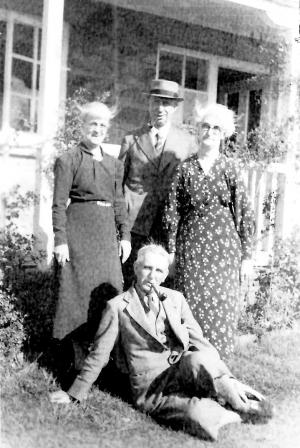
Benjamin Ineson was a lifelong friend of my grandfather Arthur Senior and like him became a local headmaster, in his case of Milll Lane School. Speaking on the presentation of a gift to my grandfather following his retirement in 1938 he said:-
"that he had known Captain Senior more years than he cared to remember. He remembered him as a tall lad at school over 50 years ago. He envied Captain Senior then because he had long trousers. Later, as a young man, he spent some hectic evenings, leaving Captain Senior's abode at four or five o'clock in the morning."6
Benjamin Ineson and my grandfather together with their wives continued this friendship, and my photo shows the four of them together. Ben was also a golfing comrade of Arthur's at Howley.
Citations
- [S8] 1881 Census RG11 for Batley (online image) "Class: RG11; Piece: 4548; Folio: 15; Page: 27; Line: ; GSU roll: 1342095."
- [S9] 1891 census RG12 for Batley (online image) "Class: RG12; Piece: 3721; Folio 36; Page 5; GSU roll: 6098831."
- [S10] 1901 census for Batley (online image) "Class: RG13; Piece: 4257; Folio: 7; Page: 5."
- [S538] Letter from Brian Arundel to V E Tomlinson.
- [S13] < and [0]>, Free BMD, Dewsbury 1903 Q4 Vol 9b p1049.
- [S30] The Batley News.
Close